-

-
-
-
Cannabis Seeds -
-
 Feminised seeds
-
Autoflower seeds
-
Regular seeds
-
High THC seeds
-
Indoor seeds
-
Outdoor seeds
-
Fast flowering cannabis seeds
-
Indica seeds
-
Sativa seeds
-
Hybrid seeds
-
Cannabis cup winners
-
Purple weed seeds
-
Greenhouse seeds
-
New cannabis seeds
-
Haze cannabis seeds
-
Skunk cannabis seeds
-
Kush cannabis seeds
-
Cookies cannabis seeds
-
Gelato cannabis seeds
-
Limited edition cannabis seeds
-
Terpene-rich cannabis seeds
-
Cali weed cannabis seeds
-
-
-
-
-
-
-
-
Cannabis Seeds
-
Feminised seeds
-
Autoflower seeds
-
Regular seeds
-
High THC seeds
-
Indoor seeds
-
Outdoor seeds
-
Fast flowering cannabis seeds
-
Indica seeds
-
Sativa seeds
-
Hybrid seeds
-
Cannabis cup winners
-
Purple weed seeds
-
Greenhouse seeds
-
New cannabis seeds
-
Haze cannabis seeds
-
Skunk cannabis seeds
-
Kush cannabis seeds
-
Cookies cannabis seeds
-
Gelato cannabis seeds
-
Limited edition cannabis seeds
-
Terpene-rich cannabis seeds
-
Cali weed cannabis seeds
-
-
-
-
-
-
-

















-
-
-
-
Cannabis Seeds -
-
Feminised seeds
-
Autoflower seeds
-
Regular seeds
-
High THC seeds
-
Indoor seeds
-
Outdoor seeds
-
Fast flowering cannabis seeds
-
Indica seeds
-
Sativa seeds
-
Hybrid seeds
-
Cannabis cup winners
-
Purple weed seeds
-
Greenhouse seeds
-
New cannabis seeds
-
Haze cannabis seeds
-
Skunk cannabis seeds
-
Kush cannabis seeds
-
Cookies cannabis seeds
-
Gelato cannabis seeds
-
Limited edition cannabis seeds
-
Terpene-rich cannabis seeds
-
Cali weed cannabis seeds
-
-
-
-
-
-
-
-
Cannabis Seeds
-
Feminised seeds
-
Autoflower seeds
-
Regular seeds
-
High THC seeds
-
Indoor seeds
-
Outdoor seeds
-
Fast flowering cannabis seeds
-
Indica seeds
-
Sativa seeds
-
Hybrid seeds
-
Cannabis cup winners
-
Purple weed seeds
-
Greenhouse seeds
-
New cannabis seeds
-
Haze cannabis seeds
-
Skunk cannabis seeds
-
Kush cannabis seeds
-
Cookies cannabis seeds
-
Gelato cannabis seeds
-
Limited edition cannabis seeds
-
Terpene-rich cannabis seeds
-
Cali weed cannabis seeds
-
-
-
-
-
-
-
Magnesium deficiency vs nutrient burn in cannabis

When growing cannabis from cannabis seeds or cuttings it's not uncommon to suspect nutrient burn if leaves show hints of yellow or brown near the tip. However, magnesium deficiency can mimic some of these signs, leading many growers to the wrong conclusion.
Getting the diagnosis wrong can seriously harm your plants. Adding extra nutrients to a magnesium-deficient crop may only increase plant stress. Flushing a plant that's already low on magnesium can stall development even further.
Here’s how to correctly distinguish magnesium deficiency from nutrient burn. And how to easily deal with it.
What is magnesium deficiency in cannabis?
Magnesium plays a vital role as a secondary macronutrient, forming a core part of chlorophyll and driving photosynthesis in your cannabis plants.
A shortage, or ‘Magnesium deficiency’ means leaves lose their vibrant green colour quickly.
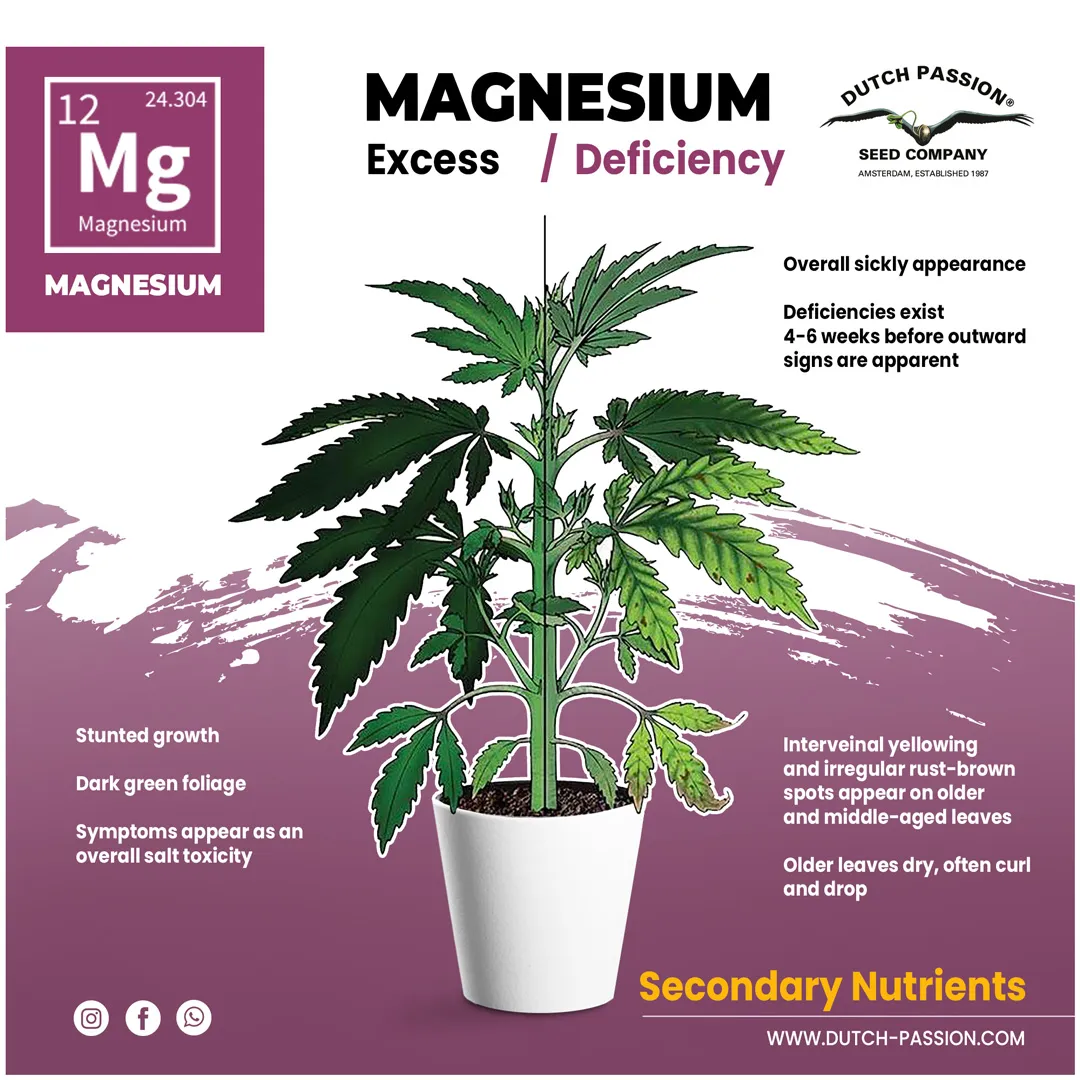
Since Magnesium is a mobile plant mineral, the plant takes it from older foliage to fuel fresh growth. This is why older/lower cannabis leaves tend to drop off first with Magnesium deficiency. The classic ‘lower leaf shedding’ is seen whether growing from feminised seeds or autoflower seeds.

Common signs of magnesium deficiency include:
• Yellowing of the leaf areas between the veins (known as interveinal chlorosis).
• Green veins standing out against pale or yellow surrounding tissue.
• Issues appearing first on the lower, older leaves.
• Rusty brown spots developing as it worsens.
• Slight upward curling of affected leaves.
• A slow, progressive onset rather than sudden change.
One key difference between Magnesium deficiency and nutrient burn can often be seen in the leaves.
With Magnesium deficiency, older leaves commonly develop interveinal chlorosis — the tissue between the veins turns light green or yellow while the veins remain darker green. Leaf edges may also become dry or crispy over time.
Nutrient burn, by contrast, usually causes burnt-looking brown tips and margins without the characteristic interveinal chlorosis. In cases of excess nutrients — especially nitrogen — leaves are often very dark green and may appear glossy or clawed.
What is nutrient burn in cannabis?
Nutrient burn occurs when your plants are fed with overly concentrated fertilisers, causing mineral salts to build up in the root zone and scorch leaf tissue from the edges inward.
The main indicators of nutrient burn include:
• Brown, crispy tips appearing first on the leaves.
• A scorched or burnt look at the leaf edges.
• Leaves sometimes turning unusually dark green (often indicating high N levels).
• Downward curling or 'clawing' of leaf edges.
• Visible salt crusting on the growing medium surface.
• Symptoms showing up rapidly, often right after a strong feed.
Magnesium deficiency vs nutrient burn: key differences

Magnesium deficiency in cannabis generally:
• Begins on the lower, older leaves.
• Features yellowing between the veins while veins stay green.
• Builds up slowly over time.
• Leads to an overall paler appearance across affected areas.

Nutrient burn generally:
• Targets the leaf tips and edges first.
• Produces brown, crispy, scorched tips.
• Hits fast following heavy nutrient applications.
• Can cause darker green leaves in certain situations.
Why magnesium deficiency is often confused with nutrient burn
Both nutrient issues create yellowing, brown patches, leaf curling, and stressed plants overall. The real giveaway is the location and pattern: magnesium deficiency issues show up as yellowing in the inner leaf areas between veins. Whereas nutrient burn starts at the outer tips and margins.
It’s also worth adding that a plant experiencing Magnesium deficiency may also be suffering from a lack of other mineral or nutrients. This can often complicate the picture, especially for the less experienced grower.
Finding a reliable feeding regime for their particular grow style can often be one of the more frustrating parts of the learning curve for the new grower.
As with all cannabis growth problems prevention is always better than cure. Soil growers should start with good quality soil, possibly with added slow-release organic nutrients for a mostly ‘water only’ grow method.
Less experienced growers may prefer to initially avoid attempting to re-use grow media. This is because recycled grow media (soil/coco etc) can require extra care and attention, it’s better suited to the slightly more experienced grower.
How to confirm magnesium deficiency

Avoid the temptation to make a hasty and potentially incorrect diagnosis. Before acting, double-check these factors:
• Ensure pH is in the optimal range to eliminate nutrient lockout. Nutrient lockout is where the nutrients are present but not bio-available due to the wrong pH.
• Review your recent nutrient strength and schedule.
• Test EC in the runoff water. Is the EC unusually high - if so, this could point towards nutrient burn as potential issue.
• Consider your water source – especially if using reverse osmosis (RO) water, which often lacks Magnesium.
How to fix magnesium deficiency

Quick recovery steps include:
• Introducing a reliable Cal-Mag supplement to your feed. Quick and easy.
• Applying Epsom salts, Magnesium sulphate, as a supplement (around 0.5-1g per litre) or as a foliar feed.
• Adjusting soil or coco pH to the ideal 6.2–6.8 range.
• Keeping your overall nutrient program balanced for healthy growth.
Perhaps most importantly, make mental notes for next time. Know the early signs of deficiency, implement learnings into your feed schedule. Improve your grow medium preparation. Consider Cal/Mag supplements as part of your future nutrient regime
How to fix nutrient burn
Over feeding, along with over watering, are two of the most common errors to affect less experienced growers. Cannabis roots will grow prolifically in the right conditions. But they are easily damaged if waterlogged or if given minerals/nutrients that are simply too concentrated. Nutrient burn damages roots, stunting growth and leaves visible brown leaf damage.

If nutrient burn is seen, don’t delay. Act quickly to prevent further damage:
• Flush the growing medium thoroughly with pH-adjusted water.
• Cut back nutrient strength significantly.
• Keep monitoring EC to track progress.
• Give plants time to recover before gradually reintroducing feeds.
Can both happen at the same time?
Unfortunately, yes. Excessive feeding leads to salt accumulation that blocks Magnesium uptake, blending the two problems. Carefully assess your nutrient levels, pH, drainage and grow-room conditions to pinpoint the root cause. Flush the plants.
Many coco growers find it best to deliberately produce run-off to try to control mineral build up. Other growers err on the side of under-feeding rather than over-feeding in an attempt to avoid nutrient burn.
Ultimately both Magnesium deficiency and nutrient burn are both relatively ‘common’ feed-related issues. Finding that easy-to-use recipe that keep your plants in the nutrient sweet spot from cannabis seed to harvest is the best way to free yourself from worry.
Prevention tips
To prevent magnesium deficiency:
• Choose well-balanced nutrients designed for cannabis.
• Check and adjust pH consistently.
• Add Cal-Mag especially when growing in coco coir or with RO water.
Avoid nutrient burn by:
• Starting at e.g. 50–75% of the suggested nutrient dose.
• Ramping up slowly as plants develop.
• Regularly checking runoff EC to stay ahead of build-up.
Frequently asked questions
Does magnesium deficiency start at the top or bottom?
It almost always begins on the older, lower leaves since magnesium moves within the plant to newer growth.
Does nutrient burn affect new growth first?
It typically shows on leaf tips across the plant, including newer growth. It often shows on leaf tips throughout the plant, even on newer foliage, due to widespread excess exposure.
Can overfeeding cause magnesium deficiency?
Yes – high salt levels trigger lockout, blocking magnesium absorption even when it's present in the feed.
Should I flush if I suspect magnesium deficiency?
Hold off at first. Test pH and nutrient strength initially. Flushing suits nutrient burn more than deficiency
How long does recovery take?
With proper fixes in place, you'll usually see healthier new growth emerging in 3–7 days.